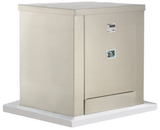
Make Any Aluminum Backflow Preventer Enclosure Blend In

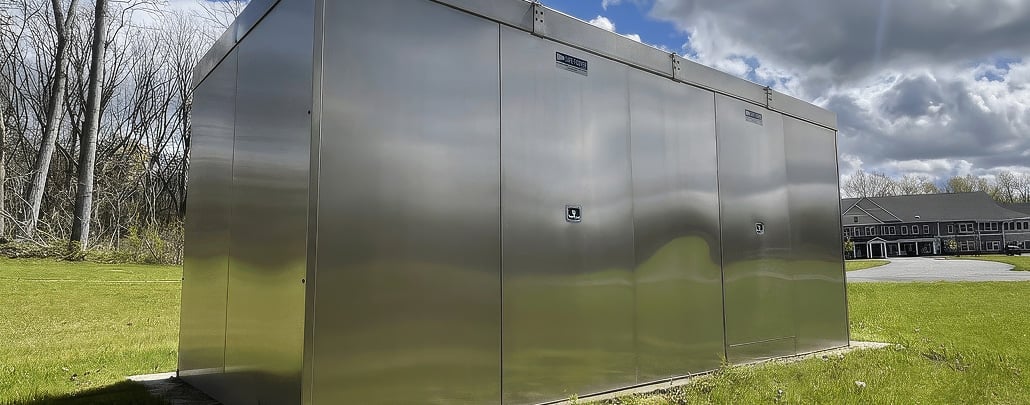
enclosure hidden in trees
Jump To Topic

5 Design Strategies for Backflow Enclosure Aesthetics

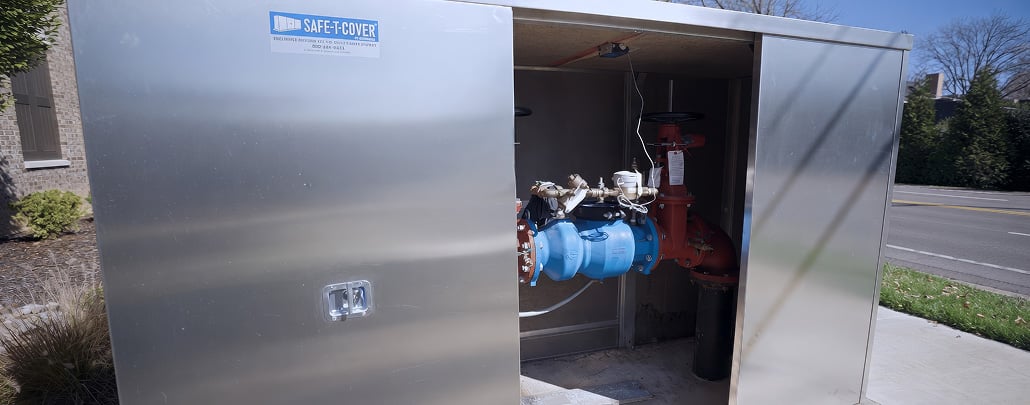
Above-ground, outdoor installation is the only code-compliant option for most backflow preventer assemblies and for good reason.

  • Underground vaults flood, create cross-connection risks and require OSHA-classified confined space entry for routine maintenance.
  • Indoor installation puts your building at serious flood risk when an RPZ assembly does its job and dumps water.

So your enclosure is important, but now you want to make it less noticeable on your property.

The good news: engineers and building owners have been solving this problem for decades. The same design strategies used to make electrical transformers and dumpsters discreet work just as well for aluminum backflow enclosures.

This guide covers five proven approaches — location, footprint, landscaping, color and vinyl wraps — and addresses real objections property owners, architects and designers raise about above-ground enclosures every day.

Why Outdoors & Above-Ground Is the Best Option

"Can't we just put it underground?" is the first question most building owners ask. For reduced pressure zone (RPZ) assemblies, the answer is a resounding no. Every manufacturer of ASSE-approved RPZs in the U.S. prohibits below-grade installation. RPZs are designed to discharge water when check valves fail, and that discharge has nowhere to go in a vault.

"What about inside the building?" That option trades one problem for a worse one. A 3-inch RPZ can discharge water at a rate that overwhelms any standard floor drain. Case studies from commercial buildings show that indoor RPZ failures have caused catastrophic flooding at costs far exceeding the price of an outdoor enclosure.

"We've always done it this way” is the most common reason outdated methods persist. While it may be difficult to change course, Las Vegas found it could save up to $60,000 per installation by switching from underground vaults to above-ground aluminum enclosures. This proves the change is worth it. Cities like Portland, Arlington, the state of New Jersey and dozens of other water jurisdictions have since updated their standard details to require above-ground enclosures entirely.

Design Consideration #1: Location

"The enclosure is going to sit right in front of our building."

This is the most common aesthetic objection and the most preventable one, because it's almost always a consequence of where the water tap was placed, not where it had to be.

Historically, civil engineers place the water tap as close as possible to a property's planned driveway location. With an above-ground enclosure in the picture, that default decision plants a large box at the most visible point on the property. It doesn't have to work this way!

The property line doesn't exist only at the front entrance or along a roadway. Backflow preventers can be installed behind or beside buildings, out of public view, and still comply with American Water Works Association (AWWA) recommended best practices.

DESIGN TIP
For optimal placement, position the backflow assembly near a zoning setback. This typically moves it out of the main sightline without adding significant pipe or excavation cost.

When front-of-building installation is unavoidable, placement still matters. An enclosure set against the property line, away from the street and behind a row of hedges reads very differently than one sitting at the entrance between the parking lot and the front door.

Think about where the electrical transformer on your property is located. Chances are someone thought about that placement. The same thinking applies here.

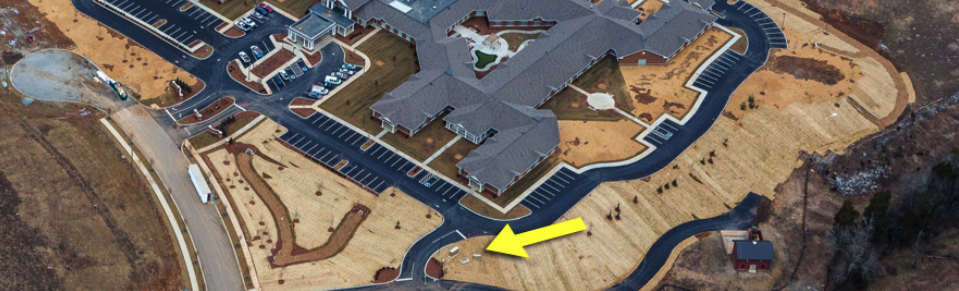
An overhead map view of property showing the backflow enclosure location not being at the main entrance to the property.

The practical rule: Engage the landscape architect and the civil engineer in the same conversation early. Jurisdictions that have used above-ground enclosures long enough have engineers who already consider enclosure placement at the design phase — not as an afterthought.

Design Consideration #2: Make the Footprint Smaller

"The enclosure is just too big."

This complaint was more valid a decade ago. It's much less true today.

Older backflow preventers — 3 inches and larger — were bulky and long. Newer N-type (or "N-pattern") backflow preventer designs changed that.

N-type assemblies are significantly more compact, and the enclosures built around them reflect that. A six-inch N-type assembly has a lay length roughly 25 percent shorter than a traditional straight-line model, and in some cases the enclosure footprint is reduced by as much as 70 percent compared to predecessors.

Both designs provide the same level of backflow protection. The package — device plus enclosure — is roughly the same price.

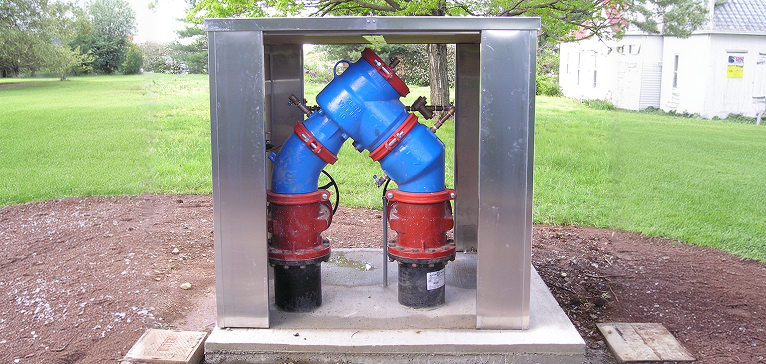
N type flow

DESIGN TIP 
Specifying a compact N-type assembly is one of the most straightforward ways to improve the aesthetic outcome of any above-ground enclosure installation before breaking ground.

A secondary strategy: consolidation. Multiple backflow preventers on a single property can often be housed in a single enclosure, reducing the total number of structures on-site and shrinking the combined footprint.

When multiple assemblies are combined, note that clearance requirements for testing and maintenance still apply. Plan for six to 12 inches between the assembly and the enclosure walls, and a minimum 12-inch clearance below the RPZ relief valve.

Design Consideration #3: Landscaping

"We didn't plan for this in the landscaping design."

Walk most new construction projects and you'll see this clearly. The building entrance gets deliberate landscaping while the parking lot islands get shrubs. The dumpster even gets a fence or a hedge row.

Meanwhile, the backflow enclosure gets nothing, left exposed because it was an afterthought in design.

Landscaping is one of the most effective and lowest-cost ways to make an enclosure disappear from view. It can be incorporated during initial site design or added after installation, making it practical even when the enclosure is already in place.

DESIGN TIP 
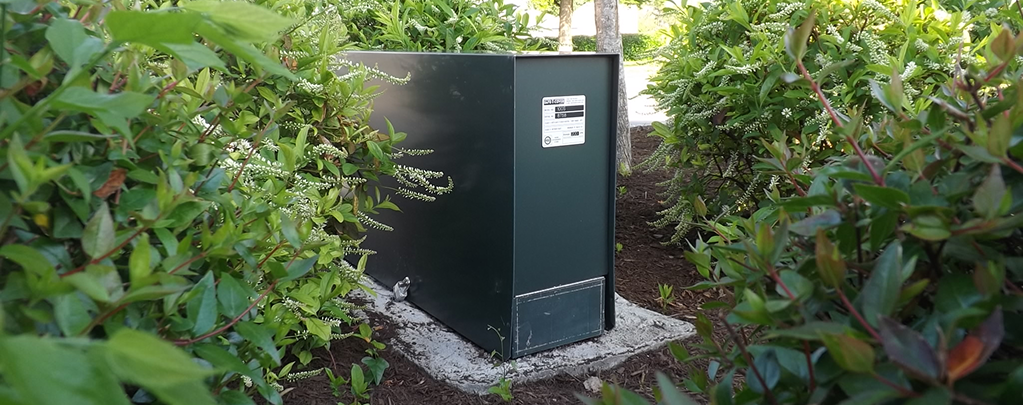
Strategic plantings — a hedge row, a dense shrub border or tall ornamental grasses — can render even a large enclosure effectively invisible from the street.


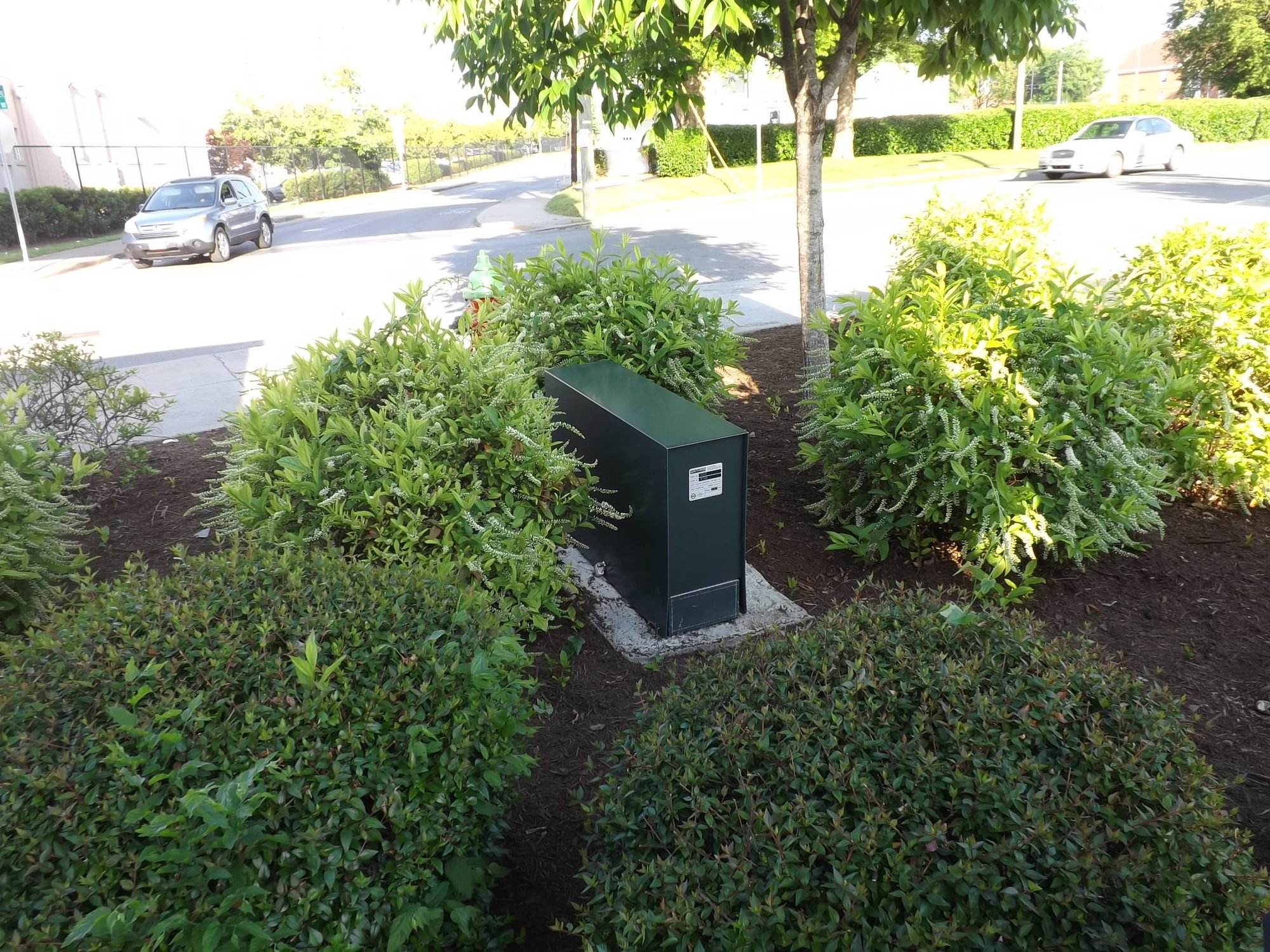
hartford green enclosure in landscaping

A few guidelines for doing landscaping right:

  • Maintain access clearance.
    Maintaining adequate space is necessary for testing, maintenance and replacement of the assemblies, as outlined by the International Plumbing Code. Keep a minimum of 3 feet between the enclosure and any landscaping. A tester needs to open panels and connect equipment. Overgrown shrubs that block the door create maintenance headaches that offset any visual benefit.

  • Choose low-maintenance species.
    Species that require infrequent trimming and maintain year-round coverage — such as Privet, which grows up to 12 feet tall and can be hedged to a consistent height — work well in most climates.

  • Check local zoning requirements.
    Some jurisdictions require that above-ground enclosures be screened by landscaping. Others specify minimum clearance distances for fire access or meter reading. If your property is governed by an HOA, the landscaping plan may also need architectural review approval. Confirm requirements before specifying plants.

  • Build it into the design package.
    Landscaping around the backflow enclosure should appear in the same site plan that covers the entrance, the parking area and the utility zones.

Design Consideration #4: Color

"We need it to match the building" or "Our HOA requires a specific color."

Both of these are solvable problems, and most designers don't realize how many color options are available at little or no additional cost.

On many commercial properties, the electrical transformer is green. It blends into the surrounding landscape so effectively that most people don't notice it. The same approach works for backflow enclosures. Safe-T-Cover's standard enclosures are available in Hartford Green, Sierra Tan, Military Brown and Brushed Aluminum at the base price. Custom colors are available for a nominal additional fee.

Standard Enclosure colors

The finish is not paint. Safe-T-Cover uses a 70 percent polyvinylidene fluoride (Kynar) coating — the same material used on commercial metal roofing — applied by PAC-CLAD, the largest manufacturer of metal roofing in the United States. The coating was originally developed for abrasive environments. It doesn't chip, it doesn't fade at the rate painted surfaces do, and it maintains its appearance over decades of outdoor exposure.

DESIGN TIP 
For properties with strict HOA color requirements or branded commercial environments, custom colors available in .050 thickness PAC-CLAD aluminum can be specified.

Design Consideration #5: Vinyl Wraps

"Is there a way to make the enclosure look like it belongs there, or even like it's supposed to be there?"

Yes! This is where vinyl wraps come in. The same technology used on branded service vehicles and architectural surfaces has found its way into the waterworks industry.

A wrapped enclosure no longer reads as a utility box. It reads as a branded surface, a mural, a brick wall, a bookshelf — whatever the designer specifies.

  • Food service businesses have wrapped enclosures to look like branded signage.
  • Commercial properties have matched brick facades.
  • Municipalities have commissioned local artists to wrap utility enclosures as public art installations.
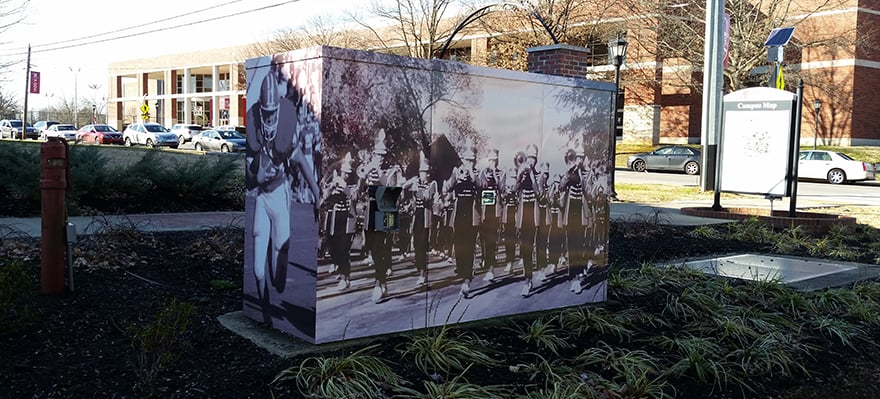
black and white imagery wrap

The process is straightforward. A wrap company's designer works with the property owner or their team to develop a concept and produces a proof for approval. Then the vinyl goes into production.

The enclosure needs to be clean and grease-free before application. Pricing varies by vendor and market, but a wrap for an enclosure of that size — including installation and a material warranty — has historically ranged from $800 to $1,200. Vinyl wrapping materials are rated to withstand long-term UV and weather exposure; a properly installed wrap should remain in good condition for seven to eight years.

DESIGN TIP
Safe-T-Cover can pre-wrap enclosures before shipping, eliminating on-site installation time. For commercial properties where the enclosure serves as a branded touchpoint at the building entrance, this option turns what was a liability into marketing square footage.

What About Other Options: Fake Rocks, Cages, Fiberglass?

"Can we just use a fake rock?"

For residential applications with small backflow preventers — two inches or smaller — decorative rock enclosures provide basic concealment. For anything larger, they're not a viable option. Here’s why they’re not recommended.

The interior dimensions of fake rock enclosures taper, meaning the device often doesn't fit even when the listed size looks sufficient. Plus, they don't lock, leaving the backflow prone to theft, and they provide no freeze protection.

"We're using a backflow cage."

Cages were a widespread response to backflow preventer theft during the 2008 recession, when copper, brass and stainless steel prices made unprotected assemblies prime theft targets. The economics that made cages attractive have since shifted.

ASSE 1060-compliant aluminum enclosures are now cost-competitive with steel cages on an upfront basis, and they outperform cages decisively when lifecycle cost is considered. A cage doesn't conceal the assembly — it frames it, advertising the presence of high-value metal to anyone who looks. An enclosed aluminum enclosure conceals the contents entirely and provides freeze protection, which a cage never will.

Marine-grade aluminum, typically 5052-H32 alloy, offers better corrosion resistance and longevity compared to standard steel cages. Enclosures can last 30 years or more due to that durability.

"Fiberglass is cheaper."

In most markets, it isn't. A popular fiberglass enclosure sized for a 3/4-inch to 1-inch backflow preventer with heat (model HF013027023) is currently listed at $2,370.34 on Grainger*. A comparable heated aluminum enclosure from Safe-T-Cover — the 100S-AL with heat— runs $892. That’s a $1,400 savings in choosing the aluminum enclosure!

*Note that contractor pricing through irrigation distributors will typically come in lower than the published retail price on Grainger. Even if that’s the case, Safe-T-Cover’s price is still substantially lower.

At larger pipe diameters, fiberglass doesn't meet full ASSE 1060 requirements and is prone to UV degradation, fiber bloom and cracking from tool impacts. Aluminum can be customized with cutouts, louvers, additional access panels and non-standard dimensions. Fiberglass can’t; any modification risks chipping or cracking.

Total Enclosure Cost: What You're Actually Comparing

"The enclosure costs too much."

When comparing the upfront cost of an aluminum enclosure against either doing nothing, using a cage or continuing to specify vaults, none are fair comparisons when lifecycle cost is included. Over a 30-year service life, the alternatives won’t save you money.

For example, a single frozen and cracked RPZ assembly can easily cost more to replace than the enclosure that would have prevented the failure.

It gets worse with vaults. Vault installations require extensive excavation and concrete construction; above-ground enclosures require only a concrete pad..

Vault maintenance requires OSHA-compliant confined space entry procedures — three people, a lift, a harness and atmospheric monitoring — every time someone tests the assembly. An above-ground enclosure is a walk-up testing procedure.

Water Meter Installed in Vault vs. Above-Ground Enclosure

If you need your decision to hold up against a budget review, here’s the rough cost of specifying a typical above-ground water meter enclosure vs. an underground vault installation. And this doesn’t even include labor/equipment savings or long lead time for vaults.
Equipment
Vault Contractor Price
Above-Ground Enclosure Contractor Price
8" meter and backflow combo (including valves, not installed)
$16,500
-
Excavator and backhoe rental to dig vault space
$2,500
-
Boom truck rental to deliver and install vault
$2,500
-
Custom enclosure for meter and backflow combo
-
$13,200
Additional gate valves and fittings
-
$2,500
Larger concrete slab required for larger backflow enclosure
-
$2,500
Total Cost
$21,500
$18,200

Find the Right Enclosure for Your Project

The five design considerations in this guide — location, footprint, landscaping, color and wraps — can be used together to get the enclosure design you want.

For example: An N-type assembly in a Slate Grey enclosure, positioned at a side setback behind a low hedge row, is not an eyesore. It's infrastructure that's been thought about, the same way electrical transformers and dumpsters get thought about on every well-designed commercial property.

The building owners, architects and engineers who have used above-ground aluminum enclosures long enough don't think of them as aesthetic problems anymore. They spec the enclosure location the same way they spec the transformer location: early, deliberately and with the finished site in mind.

For properties where the enclosure is already in place and the concern is what to do now, landscaping and vinyl wraps both work after installation. The makes the aesthetic problem solvable at any stage of the project.

Browse Safe-T-Cover's full enclosure line, or reach out to us for sizing, color options and specification help for any project type.

FAQ

Where is the best place to put a backflow enclosure to minimize visibility?

The best location is beside or behind the building, near a zoning setback and away from the main entrance. Civil engineers default to placing the water tap close to the driveway — but that puts the enclosure at the most visible point on the property. Backflow preventers can be installed behind or beside a building and still comply with AWWA best practices, so placement is a design decision, not a constraint.

Why can't the backflow preventer just go underground or inside?

For RPZ assemblies, underground installation is prohibited by every ASSE-approved manufacturer in the U.S. — the relief valve discharge has nowhere to drain safely, and vaults flood, creating cross-connection risk to the potable water supply. Indoor installation is equally problematic: an RPZ malfunction can discharge at rates exceeding 375 gallons per minute, far beyond what any standard floor drain can handle. Above-ground is the only installation that is both code-compliant and safe.

How much space does a backflow enclosure take up?

It depends on the assembly, but far less than most people expect. Newer N-pattern assemblies can reduce the required enclosure footprint by as much as 70% compared to older inline designs. Combining a water meter and backflow preventer in a single enclosure reduces the footprint further.

How close can landscaping be planted to a backflow enclosure?

Maintain a minimum of three feet of clear, level space on all sides of the enclosure so testers and technicians have unobstructed access. Some jurisdictions specify their own clearance requirements, so confirm with your local water purveyor before specifying plants.

What colors are available for aluminum backflow enclosures?

Safe-T-Cover's standard enclosures ship in Hartford Green, Military Brown, Sierra Tan and Brushed Aluminum at the base price. Additional PAC-CLAD colors (see all colors here) and custom vinyl wraps are available for installations that require a specific color match or branded finish.

Will the color on an aluminum enclosure fade or chip over time?

No. Safe-T-Cover enclosures use a 70 percent Kynar (PVDF) coating by PAC-CLAD — the same factory-applied finish used on commercial metal roofing — not paint. It won't chip, peel or fade, and is engineered to last the full service life of the enclosure, which typically exceeds 30 years.

Can I move my backflow preventer to a less visible location?

Often yes, but it requires permits, plan approval and coordination with your local water jurisdiction.

"You have some of the best customer service that I have come across, whether it be over the phone or email. Thank you for having such a high standard of excellence at your company, it makes us excited to quote and sell your products."
Nathan J.
Distributor
"Excellent, I must say, I have been doing this for almost 20 years and you guys are a pleasure to deal with."
Casey F.
New York
"We had an RPZ failure at the school I work at due to recent weather conditions here on Long Island. The floor-mounted heat sheet Safe-T-Cover offers would do a much better job."
Joe M.
New York
"The piping layout and enclosure sizing is awesome. It will make my life a little easier putting the finished product together."
Fire Protection Engineer
Rhode Island
"Safe-T-Cover provides the best answers and the fastest responses."
Distributor
Washington State
"You have really helped and I will be forwarding your information along to our facilities manager to move forward with a little more detective work. I appreciate your time and effort, and we will be in touch."
Procurement Specialist
California
"Thanks for getting back to me so quickly."
Civil Engineer
Ohio
"WOW!! Thank you. You guys are so great. Seriously, you always ship within the quoted time. We appreciate the hard work."
Waterworks Distributor
Midwest
"I've dealt with some of your competitors in the past and they do not pack enclosures like you do! Safe-T-Cover does a great job. I got one in the past that was damaged because of the packing, and the panels bounced around allowing the handles on the doors to dent the panels packed on top. It was an absolute nightmare to try and get it fixed. I don't have that problem with you!"
Distributor
"Thank you again for all your help. Safe-T-Cover has some good quality customer service and that goes a long way with me."
Contractor
Las Vegas, NV

Not Sure A Standard Sized Aluminum Enclosure Will Work?

Check out our custom enclosures instead.
We can make them in nearly any size with extra features.