Most backflow preventer assemblies get specified with one line: “provide and install BPA per local code.” That’s enough to get a permit and pass inspection, but not enough to get the best-performing, most cost-effective installation.
Choosing the right enclosures for backflow devices means picking the right assembly type, hydraulic profile and ASSE 1060 class. These decisions all affect project cost, system performance, freeze protection and site aesthetics. When left off the initial bid package, each one has consequences that can surface later when they’re harder to fix.
When specifying, first check your local design requirements. In many jurisdictions, above-ground backflow enclosures are mandated by local code, and noncompliance can result in fines, legal liability or direct threats to public health.
Now let's dive into the four specifications that belong in every backflow prevention project: size, hydraulics, ASSE 1060 class and aesthetics.
Size matters: Specify n-type
Until a few years ago, most flange-sized assemblies shared a single conventional form factor: a vertical riser through the concrete slab, a 90-degree turn, a series of horizontally oriented gates and valves, then another 90-degree turn back through the slab. The result is a long, wide footprint.
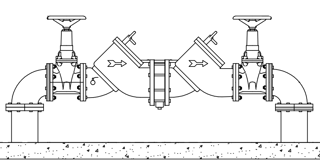
N-type assemblies reorient the shutoff valves into the horizontal plane, placing the 90-degree turns within the boundaries of the shutoff valves rather than beyond them. The result is a significantly more compact backflow device assembly.
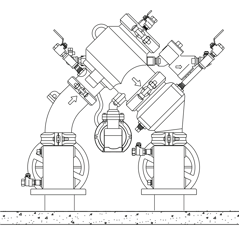
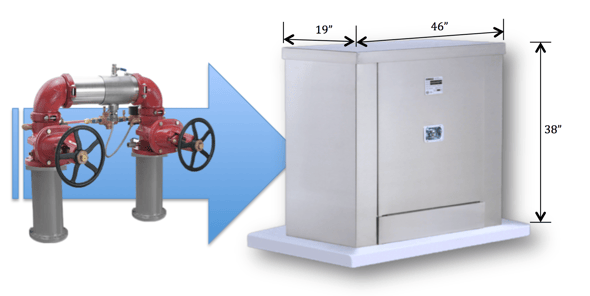
For larger pipe sizes, the size reduction is even more pronounced. Backflow enclosures for conventional flange-sized assemblies can be as much as 70 percent larger than those designed for N-type equivalents.
N-types have grown in popularity over the last decade. Major manufacturers now offer robust N-type lines and market demand for compact assemblies is growing.
Choosing an N-type backflow assembly doesn't have to cost more when you factor in the enclosure. N-type assemblies are more compact than traditional straight-line models — a six-inch N-type, for example, has a lay length 25 percent shorter than a conventional design. Smaller internal dimensions mean a smaller enclosure, and that size reduction brings the enclosure cost down enough to offset the difference in assembly price. The total package is comparable.
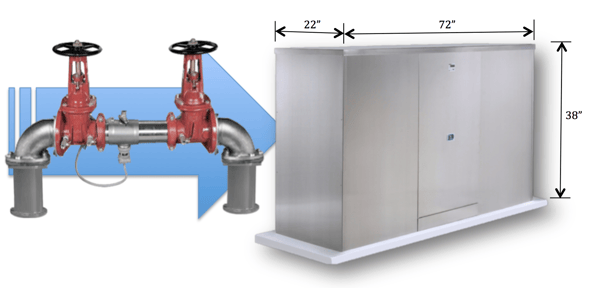
The catch is that most bids don't include the enclosure in the first place. Supply houses understand this dynamic, but since the enclosure often isn't specified until late in the project, it gets left out of the initial bid. When only the assembly cost is being compared, the savings from the smaller enclosure never show up, and the numbers look uneven when they aren't.
The fix is simple: always specify N-type as your assembly type. You don't have to commit to a specific manufacturer or model number. Every major manufacturer's N-type design is more compact than their conventional equivalent, so specifying N-type guarantees a smaller footprint — and a more cost-competitive total package — regardless of which brand gets installed.
Hydraulics Matter: Specify Best-in-Class
All backflow prevention assemblies are not hydraulically equivalent. Head loss — the pressure drop across the assembly at rated flow — varies by manufacturer and by pipe size, and no single manufacturer produces the best-performing assembly across every pipe diameter.
Specifying "equal or approved equivalent" without calling out hydraulic performance criteria allows for substitutions that may significantly underperform for the pipe size in question.
Head loss is measured in atmospheric pounds per square inch (APSI). Flow capacities for each manufacturer's assemblies are based on rated flow — the maximum continuous duty performance as determined by AWWA standards.
To select the best-performing assembly for a given pipe size, compare head loss values across the major manufacturers at the rated flow for that diameter. The head loss number is shown in APSI. Conventional (larger enclosure) models are differentiated from N-type models in the comparison chart.
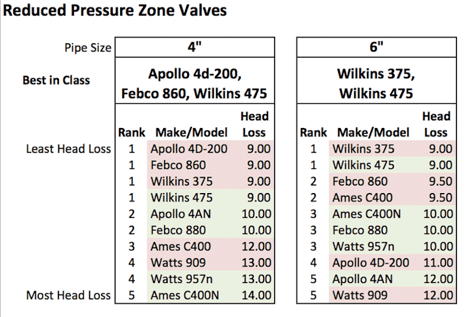
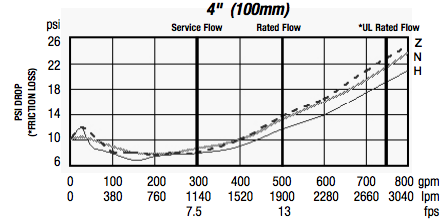
The flow capacities in this chart are provided by each manufacturer's website. They identify valve performance based on Rated Flow rates of maximum continuous duty performance determined by AWWA. The chart below shows the flow characteristics of the Watts 957. All three variations are graphed. The data reflected in our chart is for the 957N of 13 APSI.
ASSE 1060 Class Matters: Specify Freeze Protection
ASSE Standard 1060: Performance Requirements for Outdoor Enclosures for Fluid Conveying Components was introduced in 1996 by the American Society of Sanitary Engineering to regulate the backflow enclosure industry. It has been updated several times, most recently in 2017.
For installations in freezing temperatures — or any climate where a freeze event is possible — Class I is the required classification. Class I enclosures must maintain a minimum interior temperature of 40°F when the outside temperature drops to −30°F, with a minimum thermal resistance (R) value of 8.0. Properly insulated and heated enclosures that meet this standard prevent pipes from rupturing and valves from cracking during extreme cold, even in sub-zero conditions.
Beyond freeze protection, ASSE 1060 also requires adequate testing access (test cocks and valve handles within 24 inches of the access opening), secure lockable access, structural integrity of at least 100 psf vertical load and drainage capacity sufficient to handle RPZ relief valve discharge without submerging the equipment.
A well-designed enclosure that meets these access requirements simplifies routine maintenance, making it easier for technicians to perform inspections and testing without exposing equipment to damage.
Specifying Heater Type
In 2006, the ASSE 1060 standards committee amended the Class I guidance after discovering that the heater units in the vast majority of available enclosures — standard wall heaters available from general supply — were not rated for wet or damp conditions. The amended standard specifies:
"Enclosure shall be heated to maintain an interior temperature of 40° with an outside temperature of as low as −30°. Heater source shall be listed by an independent product safety listing organization as 'suitable for wet and damp environments.'"
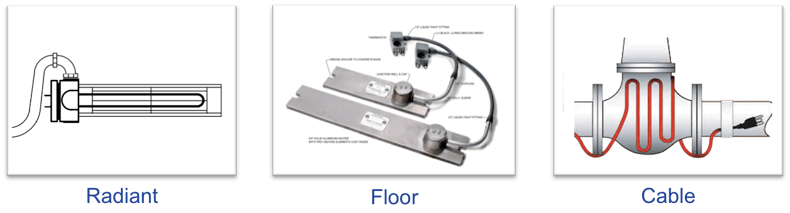
North Carolina took this requirement seriously. When the state retrofitted 55 double-check backflow assemblies — moving them from underground vaults to above-ground RPZs in ASSE 1060 enclosures — officials reviewed every heater option on the market. Only three met the Class I standard: radiant heat, a sealed floor heater (Safe-T-Cover's design) and cable-wrap heat tape.
Of those three, cable wrap is the weakest option for larger pipes. At five watts per foot, it struggles to keep up on anything larger than two inches.
Wall Heaters Leave the Ground Cold
While still in use and not necessarily ASSE 1060 certified, wall heaters can't match the freeze protection of a floor heater. Two installation constraints work against them. First, the enclosure door forces the heater to mount off to one side rather than centered. Second, because wall heaters don't meet wet/damp location requirements, they must be mounted at least 12 inches above the slab — well above the coldest air in the enclosure.
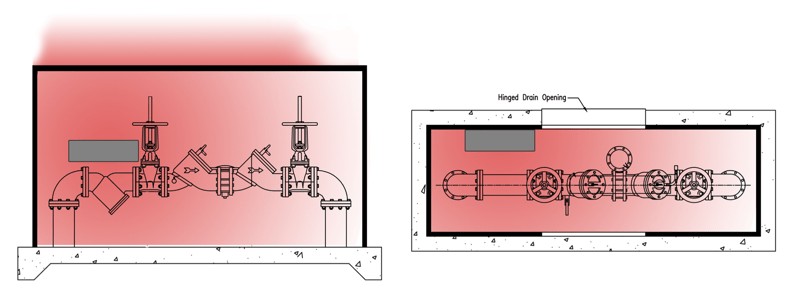
That placement is the core problem. Heat rises, so a wall heater mounted a foot off the ground pushes warm air straight up and out through the top of the enclosure before the interior ever reaches a consistent temperature. The equipment near the slab — exactly where freezing starts — stays cold.
Floor Heaters Meet the ASSE Class I Standard
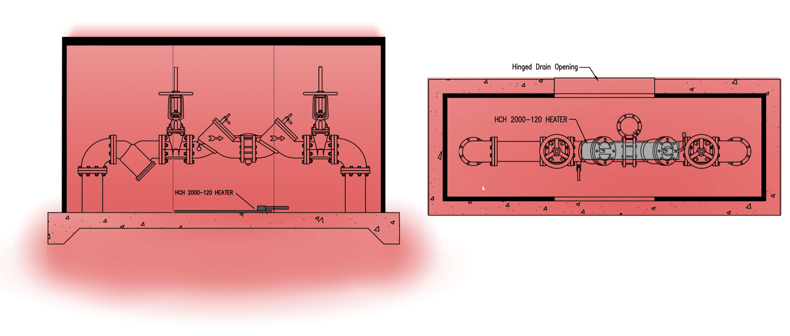
A slab-mounted floor heater bolts directly to the concrete and produces conductive heat that penetrates as much as 16 inches down into the vertical riser pipes. In side-by-side testing conducted by the Department of Mechanical Engineering at Tennessee Technological University in 1997, a floor heater produced up to 32 percent fewer thermostat on/off cycles on cold-weather days compared to a wall-mounted unit. Safe-T-Cover doubles roof insulation to R-18 to further stabilize interior temperature in freezing conditions.
Aesthetics Matter: Specify Color
Safe-T-Cover offers its full line of marine grade aluminum backflow enclosures in four standard colors at base price: Hartford Green, Sierra Tan, Military Brown and Brushed Aluminum. Custom colors are available for a small additional cost.
Aluminum is the preferred enclosure material for outdoor installations: it's lightweight, corrosion-resistant and well-suited for exposure to the elements, while still supporting custom sizing and color options. Compared to stainless steel, aluminum offers comparable durability at a significantly lower weight and cost.
Specifying a color at the design stage costs nothing and prevents a brushed aluminum box from landing in front of a building where a neutral or landscape-blending finish would have served the site better. It's one of the easiest specification decisions available — and one of the most commonly skipped.
Specifying color and placement at the design stage also supports site security: a well-positioned, finished enclosure discourages vandalism and deters unauthorized access to water protection equipment.
For a full review of color options, landscaping strategies, vinyl wraps and placement considerations, read the Backflow Enclosure Aesthetics Guide.
Backflow Preventer Specification Checklist
Four items belong in any backflow preventer specification from the design phase forward.
| Specification Decision | What to Call Out | Why It Matters |
|---|---|---|
| Assembly Type | Specify N-type | Reduces assembly footprint by up to 25% per pipe size; smaller enclosure offsets added assembly cost |
| Hydraulic Performance | Specify best-in-class head loss for the required pipe size using comparative data | No single manufacturer leads at every pipe size; substitutions without this criterion may underperform |
| ASSE 1060 Class | Specify Class I with a heater rated for wet/damp environments | Most market enclosures fail the 2006 heater amendment; non-compliant heaters cannot deliver uniform freeze protection |
| Enclosure Color | Specify Hartford Green, Sierra Tan, Military Brown, or Brushed Aluminum | Default is brushed aluminum; the four colors cost nothing extra but must be specified to receive them; additional PAC-CLAD colors are available for a nominal fee |
Backflow Enclosures in Custom Sizes
If you've read this far and you're thinking, "This is great, but I need custom sizes for my enclosures," reach out for a free quote. In addition to standard sizes, Safe-T-Cover has built hundreds of custom enclosures to exact specifications on tight timelines.


.jpg?width=206&name=MadeInUSA-Icon%20(1).jpg "MadeInUSA-Icon (1)")