Getting enclosure sizing right is one of the most consequential decisions in a backflow installation, and one of the most misunderstood. Engineers and facility managers often default to ordering oversized boxes “just to be safe,” but that approach adds cost without adding value.
Save yourself time and money by requesting a free custom enclosure sizing quote and engineering drawing from us, often within a single business day. Here's how.
Why Getting the Right Enclosure Size Matters
Enclosure size is the single biggest driver of cost. An enclosure that’s too large wastes material and may create clearance issues at the site. One that’s too small restricts maintenance access — potentially putting you out of compliance with ASSE 1060 and local jurisdiction requirements.
If you've explored the wide range of standard enclosures and it's clear they still won't work for your project, your next step is a custom enclosure.
The right size custom aluminum enclosure protects your assembly, supports code compliance and keeps your project on budget. It also determines how well the enclosure performs across its lifecycle. Adequate space around the backflow assembly ensures test crews can work efficiently, that relief valve discharge drains correctly and that insulation performs as designed in cold-weather applications.
Beyond equipment protection, enclosure dimensions must account for the people doing the work. Good sizing practice means leaving enough space for staff to safely perform maintenance without awkward maneuvering, restricted movement or workarounds that slow inspection cycles.
Common Mistakes in Enclosure Sizing
Most sizing errors fall into a predictable range. Understanding them upfront can save significant cost and rework:
- Ordering a larger enclosure than the equipment requires, assuming bigger is always safer
- Failing to account for internal dimensions separately from external dimensions; wall thickness reduces usable interior space
- Ignoring service access requirements, which affects both width and depth
- Underestimating heat dissipation needs in warmer climates or enclosed mechanical areas
- Choosing a cheaper enclosure material that won’t hold up to the outdoor environment
Start With a Sketch
The fastest way to begin the sizing process is also the simplest: draw it out by hand. A rough sketch of your piping layout — including the assembly configuration, pipe diameters, valve orientation and connection points — gives Safe-T-Cover’s design team everything needed to recommend the right enclosure dimensions.
Your sketch doesn’t need to be to scale or professionally rendered. Measure what you can and include:
- Piping layout and flow direction
- Valve types, sizes and approximate dimensions (width, depth, height) in inches
- Desired access panel locations and door swing direction
- Pipe penetrations through the enclosure floor or walls
- Site constraints such as proximity to walls, fences or ground-level obstructions
Once you have a sketch, email it to info@safe-t-cover.com. If you send it during business hours, you’ll typically hear back within a few hours.
What Happens After You Send the Sketch
Safe-T-Cover’s design engineers take your sketch and use it to develop a best-practice layout for your equipment. The process is fast:
- The engineering team reviews your piping configuration and optimizes the layout for clearance, drainage and access.
- The enclosure is sized precisely including internal dimensions, access panel placement, mounting details and pipe penetration locations.
- An engineering estimate and drawing are delivered, typically within one business day.
- CAD files are available upon request at no charge.
This entire process — from sketch submission to quote and drawing — is provided at no cost. There’s no obligation to purchase. Our mission is to protect the drinking water supply, and we believe above-ground enclosures are the best solution in the industry. That’s why we share our tips and expertise freely.
Top Sizing Considerations for Custom Backflow Enclosures
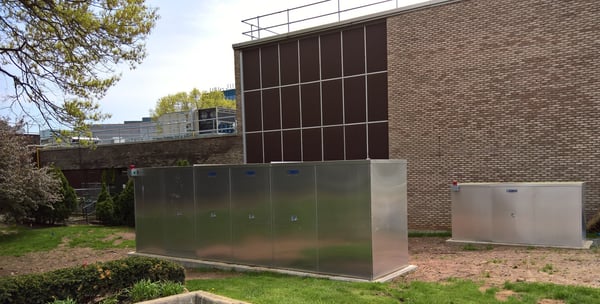
When Safe-T-Cover’s team evaluates your configuration, several design factors inform the final enclosure dimensions:
Maintenance Clearance and Service Access
ASSE 1060 and most jurisdictions require 6 to 12 inches of clearance around the assembly for test and maintenance access. But clearance isn’t just a code checkbox: it’s a safety requirement. Enclosures need enough space for staff to safely enter or perform maintenance without being forced into awkward positions or restricted movement. Cramped enclosures slow inspection cycles and can create compliance issues during plan review. Sufficient clearance is non-negotiable.
Relief Valve Discharge Clearance
RPZ assemblies require a minimum of 12 inches of clearance below the relief valve to allow proper drainage without backpressure or pooling. This is a critical design requirement that affects both enclosure height and drainage configuration.
Internal vs. External Dimensions and Wall Thickness
One of the most common sizing errors is conflating internal and external dimensions. Wall thickness — typically 1.5 to 3 inches depending on insulation class — directly reduces usable interior space. Always confirm internal measurements against your equipment’s length, width and height before finalizing an enclosure size. Safe-T-Cover’s engineering team handles this calculation as part of the standard sizing process.
Assembly Diameter and Pipe Orientation
Enclosure width and depth are driven primarily by the size of the backflow assembly and the piping configuration. N-pattern (90-degree) assemblies significantly reduce the footprint compared to standard inline configurations — in some cases by up to 70 percent. If your layout allows for an N-pattern assembly, it’s worth exploring before finalizing dimensions. It’s a practical way to optimize the enclosure size and potentially save on material costs.
Heat Dissipation and Thermal Performance
In warmer outdoor environments, heat buildup inside an enclosure can shorten equipment lifespan. Larger assemblies and motors generate significant heat, and an enclosure that’s too tight will trap it. Sizing for adequate airflow — or specifying exhaust fans where needed — is part of a complete thermal protection strategy. For cold-weather applications, Class 1 ASSE 1060 heated enclosures maintain internal temperatures above 40°F even when outdoor temperatures drop to -30°F. Safe-T-Cover uses 1.5-inch R-9 insulation in wall panels and 3-inch R-18 in roof panels as standard.
Site Constraints, Environment and Custom Builds
Outdoor enclosures must account for the full range of environmental conditions at the installation site — UV exposure, wind load, and ground-level flooding risk. Safe-T-Cover’s modular panel system accommodates a wide range of installation conditions. If a standard enclosure doesn’t fit your site, custom enclosures can be built to exact dimensions.
Get Your Free Custom Sizing Quote
Sketch your piping configuration and email it to info@safe-t-cover.com. Safe-T-Cover’s design team will follow up with a layout recommendation, enclosure sizing and a no-obligation quote, typically within one business day.
You can also call us or chat on our website to speak with an enclosure specialist directly.
FAQ: Custom Enclosure Sizing
How quickly can I get a quote?
Safe-T-Cover can typically provide a quote within a few minutes to a few hours. We supply engineering drawings within a few business days or less.
What if a standard size enclosure doesn’t fit my equipment?
Custom builds are available to exact dimensions. The modular panel design allows Safe-T-Cover to accommodate unusually large or small installations without premium lead times.
Is there a cost to receive drawings and specifications?
No. Drawings, specifications and CAD files are provided at no charge as part of the design consultation process.
Which ASSE 1060 class do I need?
That depends on your location and climate exposure:
- Class 1 (heated) maintains internal temperatures above 40°F even when outdoor temperatures drop to -30°F
- Class 2 (insulated, non-heated) provides freeze retardation in mild climates
When in doubt, specify Class 1. Most jurisdictions updating their standard details are moving in that direction.
What happens during a power failure?
During a power outage, the heater stops working and the insulation alone protects your equipment from the cold. That’s why Safe-T-Cover uses 1.5-inch R-9 insulation in wall panels and 3-inch R-18 in roof panels as standard, providing a meaningful buffer even when the power is out for a short time. We also sell a TAPF alarm that will alert you to power failures.


.jpg?width=206&name=MadeInUSA-Icon%20(1).jpg "MadeInUSA-Icon (1)")