Indoor backflow preventer installation costs building owners far more than the price of the backflow prevention device itself. Every square foot the assembly and its clearances occupy is square footage that can't be leased.
Over a 25-year building life, that lost-revenue figure routinely exceeds the full installed cost of moving the backflow preventer outside into an ASSE 1060-certified enclosure, and that's before any flood event or tenant reclassification gets factored in.
Why the Indoor Backflow Preventer Installation Process Costs More Than the Device
Plumbing engineers still design reduced pressure zone (RPZ) backflow preventers inside commercial buildings. The flood risk from these reduced pressure assemblies is well-documented: flow rate charts from manufacturers like Watts and Wilkins show how much water an RPZ relief valve can discharge, and there are now flood control valves on the market specifically because the industry has acknowledged the hazard.
Local plumbing codes treat indoor backflow installations with extra scrutiny precisely because of the water damage exposure they create, and any indoor specification has to clear those local code requirements before it gets approved.
Beyond this risk, several hidden costs should be considered for every indoor installation. The sticker price of an RPZ assembly is the smallest part of what it costs a building owner. The bigger costs include:
- Lost rentable square footage
- Exposure to retrofit when a tenant's hazard level changes
- The liability that comes with discharging hundreds of gallons of water inside an occupied building.
How Much Space Does a Backflow Preventer Inside a Mechanical Room Take?
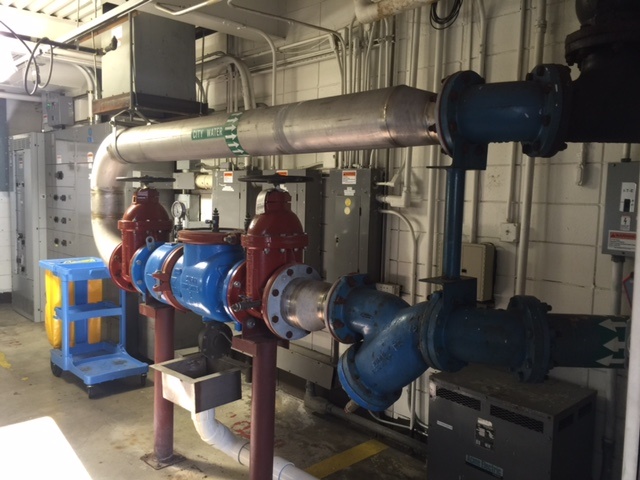
The smallest flange-sized RPZ — a 3″ device — needs roughly 33 square feet of indoor space at the bare minimum. Plans reviewers, architects and design engineers consistently say that figure is too small in practice. Recurring feedback has been the same at chapter events held by ASPE and ABPA: 33 square feet is not a realistic estimate.
A 3″ RPZ is one of the smallest assemblies in the field. Indoor installations are far more often in the 4″ to 8″ range. It's common to see an 8″ double check valve assembly on a fire protection line and a 4″ RP on a domestic water supply line side by side in a single mechanical room.
Required footprint grows exponentially with pipe diameter. A 6″ RPZ can require up to four times the footprint of a 3″ RP. The same scaling applies to DC valve assemblies and double check detector assemblies (DCDA) for a water system. Mechanical rooms holding indoor backflow assemblies are not the size of closets. They're large and the most common complaint architects report hearing from planners is that there's not enough room for the backflow preventer.
Clearance Requirements That Grow Room Size
Code-required clearances around the assembly compound the footprint problem. In our Standard Details for Above-Ground Enclosures Guide, we share that typical clearance requirements for proper installation include:
- 6 to 12 inches between the assembly and adjacent walls — needed for test cock access during regular inspection
- 12 to 24 inches between centerlines when multiple backflow prevention assemblies share a space (for example, a domestic line and a fire line together)
- A minimum of 12 inches below an RPZ relief valve to prevent submersion during relief valve discharge
- Six inches above the shutoff valve for wrench access to the handwheel
Every inch of clearance is space the building owner pays for and can't lease. Plus, specifying an accessible installation location affects annual certified testing, valve cleaning and component replacement. A cramped indoor space drives those service costs up over the life of the assembly.
What Does That Lost Space Cost a Building Owner?
Let's run the numbers on the smallest possible scenario: 33 square feet with a 3″ RPZ on the main water supply line. Keep in mind that plan reviewers say this is too small, but we'll calculate the lowest cost scenario because you'll save even more with anything bigger.
Using the national average commercial office rent of $32.91 per square foot in April 2026 (rounded to $33)*, a 25-year building life , a 9% discount rate and a 2.6% annual rent escalator, the net present value (NPV) of that lost space is approximately $13,267.
*Building owners in higher-rent markets — Manhattan, San Francisco or Austin — should run the same calculation against their local lease rate. The math gets more lopsided as the rent climbs.
That figure scales sharply with diameter. A 6″ RPZ in the same building, occupying up to four times the footprint, pushes the NPV well above $50,000 for the floor space alone.
Now compare that to the all-in cost of moving the assembly outside. The table below uses two common RPZ models from the field: the Watts 957 NRS, a traditional configuration, and the Watts 957N NRS, an N-type assembly with a meaningfully smaller footprint and lower enclosure cost.
|
Cost line item |
Watts 957 NRS (traditional) |
Watts 957N NRS (N-type) |
|
Above-ground enclosure |
$3,756 |
$1,265 |
|
Concrete pad |
$1,200 |
$1,000 |
|
Electrical for heater |
$1,800 |
$1,800 |
|
Outdoor installation total |
$6,756 |
$4,065 |
|
NPV of lost indoor sq ft (25 yr, $33/sq ft, 9% discount rate, 2.6% rent escalator) |
$13,267 |
$13,267 |
|
Net savings vs. indoor installation |
+$6,511 |
+$9,202 |
Even on the traditional 957 NRS, choosing outdoor installation preserves nearly 2x its cost in interior space value over 25 years. With the N-type 957N, the gap widens to more than $9,200 in preserved space value — and that's still before any cost is assigned to the avoided flood risk or retrofit exposure.
3 Scenarios That Make Indoor Costs Worse
Several future events are common enough that they should be priced into any indoor backflow preventer installation.
1. Tenant Turnover Triggers a Hazard Reclassification
A DC valve assembly serving a low-hazard tenant is acceptable. When that space turns over and the new tenant is classified as high hazard — a use case that becomes more common with every leasing cycle — the DC must be replaced with an RPZ. That's a forced retrofit inside an occupied building, plus the continued opportunity cost of an oversized mechanical room.
2. Cross-Connection Control Programs Redefine High Hazard
Water purveyors update their cross-connection control rules. When they do, low-hazard users get reclassified as high hazard without changing tenants at all. Same retrofit outcome with no warning or choice in the timing. A growing cross-connection inventory in any given service area tends to mean more reduced pressure principle assemblies in service and more frequent reclassifications.
3. Catastrophic RPZ Flooding
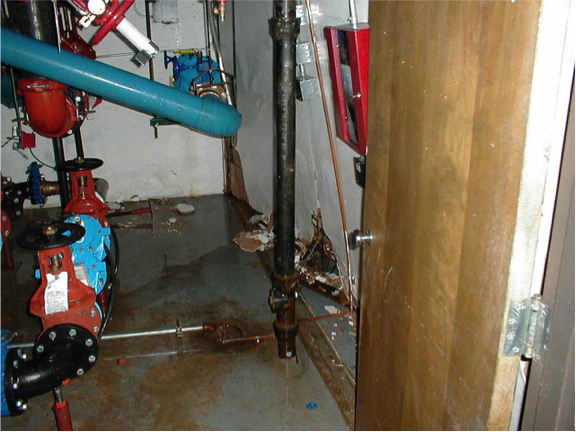
An RPZ relief valve can discharge over 375 gallons per minute of water depending on assembly size and supply pressure. That contaminated water is dumped to protect the potable water supply from a backflow condition or cross-connection — exactly how the backflow preventer functions. We've seen inside a hospital mechanical room flood that caused over $1 million in damages and the engineer, architect, contractor, subcontractor and most recent tester were all involved in the insurance claim and recovery. While details weren't made public, we do know that one or more of the listed parties had to pay for damages.
Why Above-Ground Beats Every Indoor or Below-Grade Alternative
Above-ground backflow installations in ASSE 1060-certified enclosures return 100 percent of the interior space to the rent roll, hold a minimum 40°F internal temperature down to -30°F external, provide drainage sized for full relief valve discharge, and meet code in jurisdictions increasingly moving away from vault and cage specifications. Below-grade vaults, by contrast, are classified by OSHA as confined spaces, raising the cost and risk of every test, cleaning and component replacement event over the life of the assembly.
Move Backflow Preventer Installation Outside on Your Next Project
For design engineers, plans reviewers and architects working to prevent drinking water contamination, the path is straightforward:
- Size the enclosure to the assembly footprint plus the required clearances (6 -12 inches to walls, 12 inches below the relief valve, 6 inches above the shutoff valve).
- Confirm correct installation orientation per the manufacturer's specifications — most manufacturers require RPZ assemblies installed horizontally with the relief valve port oriented downward.
- Specify ASSE 1060 Class 1 for any site where a freeze event is even remotely possible — including traditionally warm regions like Florida, Texas and Arizona, all of which have seen widespread backflow failures during cold snaps. A Class 1 heated enclosure handles the freeze protection job that loose insulation or seasonal line-draining on irrigation systems does, neither of which reliably prevents ice expansion that cracks valve bodies and pipes.
- Verify drainage capacity against ASSE 1060 Table 3 for the pipe diameter at hand
|
Diameter |
Backflow Preventer Enclosure |
|
¼" to ½" |
27 GPM |
|
¾" to 1" |
45 GPM |
|
1 ¼" to 2" |
155 GPM |
|
2 ½" to 3" |
260 GPM |
|
4" and above |
710 GPM |
- Confirm power supply for a slab-mounted heater
- Consider an N-type assembly where the application allows because a smaller footprint reduces enclosure cost and shortens lead time
For free quotes and expert sizing help, reach out to our team via chat or contact us here and learn more best practices for backflow prevention.

.jpg?width=206&name=MadeInUSA-Icon%20(1).jpg "MadeInUSA-Icon (1)")