When you choose the right backflow cover, you're protecting high-value assemblies from freezing temperatures, theft, tampering and flooding — while satisfying jurisdictional standards and giving testers and maintenance personnel safe, ready access.
That's a lot of jobs to do, and only one type of cover can handle all of them: A heated ASSE 1060 Class I aluminum backflow cover is the right specification for any commercial backflow preventer installation where a freeze event is even remotely possible.
Here's what a backflow cover does, how the ASSE 1060 classes differ, which materials hold up in extreme weather and how to size and specify the enclosure your project needs.
What a Backflow Cover Does
Specifiers see backflow covers called out on renderings as a generic shape, but the enclosure is much more than a box or a line on a drawing. A properly specified backflow preventer cover does four things:
- Protects high-value components from theft and vandalism
- Prevents freeze damage to check valves, relief valves and connected piping
- Eliminates cross-connection risk from submerged or flooded equipment
- Maintains code compliance and gives testers safe access for annual inspections
Water that freezes inside a backflow assembly can crack the device's metal or plastic components, which is why outdoor freeze protection is critical anywhere temperatures fall below 32°F. If a cover fails to protect, the backflow assembly is out of commission and could cause a major disruption or contamination to the water supply. Replacement backflow assemblies rarely sit on shelves at local waterworks supply houses. Pick the right cover from the start.
Look for ASSE 1060 Certification
Before 1996, the market was full of fiberglass boxes that offered no insulation, drainage or security for backflow preventers. That year, the American Society of Sanitary Engineering introduced ASSE 1060 to set performance and safety standards for outdoor enclosures protecting backflow preventer devices and other fluid-conveying components.
Manufacturers earn ASSE 1060 certification by submitting products to an ASSE-approved lab for testing. Once a product passes, it carries an official rating. Many jurisdictions writing standard details now require ASSE 1060 compliance.
The standard governs five performance dimensions: structural load (100 psf vertical minimum), drainage capability (sized to RPZ discharge), access for testing, security and materials of construction.
Note that a specification reading only "ASSE 1060 certified" without naming a class is incomplete. The class determines whether the enclosure is heated, insulated or neither — and that is the most consequential decision in the entire spec.
ASSE 1060 Classes for Freeze Protection: Which One Do You Need?
ASSE 1060 defines three primary classes that correspond to freeze protection, frost protection and no freeze protection.
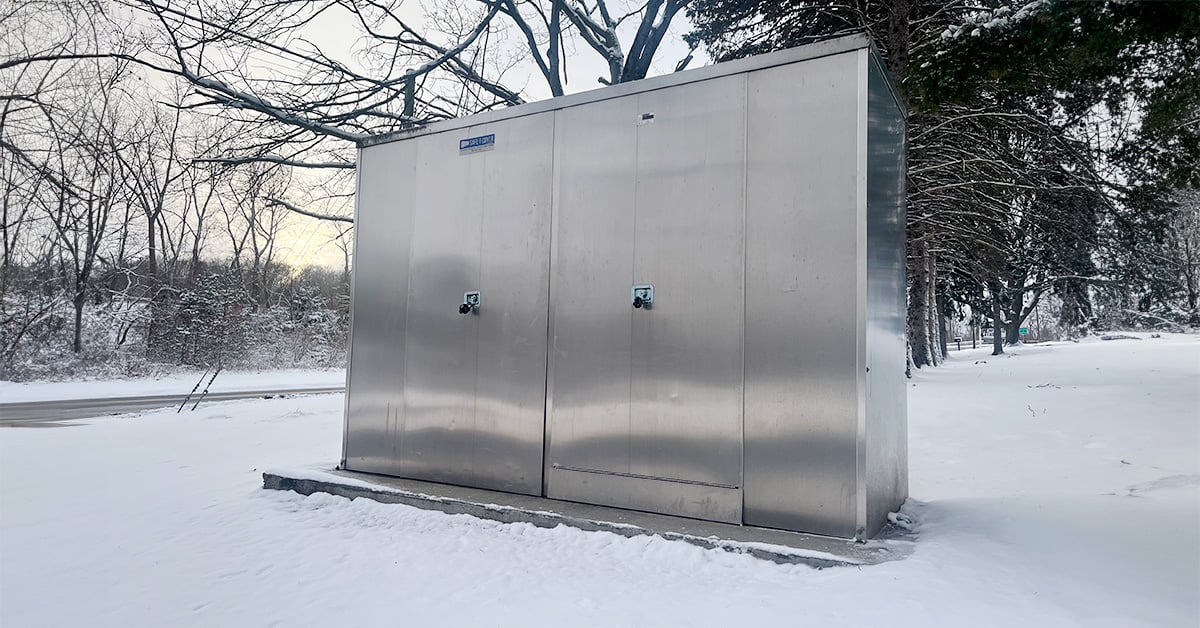
Class I: Heated Backflow Preventer Cover
A Class I enclosure is designed and constructed to maintain a minimum internal temperature of 40°F when the external temperature drops to -30°F, with a minimum thermal resistance (R) value of 8.0. Class I enclosures include a positive means of heat, most commonly a slab-mounted heater wired to the enclosure. This is the only class that combines insulation with an active heat source — engineered to withstand both winter cold and strong winds.
Class II: Freeze Retardant Backflow Insulation Cover
A Class II backflow insulation cover is insulated to a minimum R-value of 8.0 and designed to maintain 40°F internally for a 24-hour period without active heat. Freeze protection is limited to whatever the insulation cover alone can hold.
Class III: Security Only
A Class III enclosure has no freeze protection requirement and no minimum R-value. It is built strictly to deter theft, vandalism and incidental damage. Safe-T-Cover does not recommend or manufacture Class III enclosures. Most modern standard details rule them out for any assembly that holds water year-round.
Side-by-Side: ASSE Class I, Class II and Class III
| Class | Heated | Min R-Value | Performance Requirement | Best For |
|---|---|---|---|---|
| Class I | Yes | 8.0 | Maintains 40°F internal at -30°F external | Any site with a possible freeze event |
| Class II | Optional | 8.0 | Maintains 40°F internal for 24 hours, no heat required | Only climates that never dip below 33°F |
| Class III | No | None | No freeze protection requirement | Not recommended |
When in Doubt, Specify Class I for Cold Weather Protection
For any location where a freeze is possible, a Class I heated enclosure is the right specification. Sun Belt freeze events happen regularly. Orlando and Miami lost thousands of backflow preventers to a freeze in 2010. Texas freezes in 2021 and again in 2025 caused backflow damage across the state.
Safe-T-Cover routinely ships heated Class I enclosures to projects across Texas, Louisiana, Mississippi, Alabama, Georgia and Florida for this very reason — locations where intense sun is the typical concern but a single cold-weather event can wipe out an unprotected backflow device.
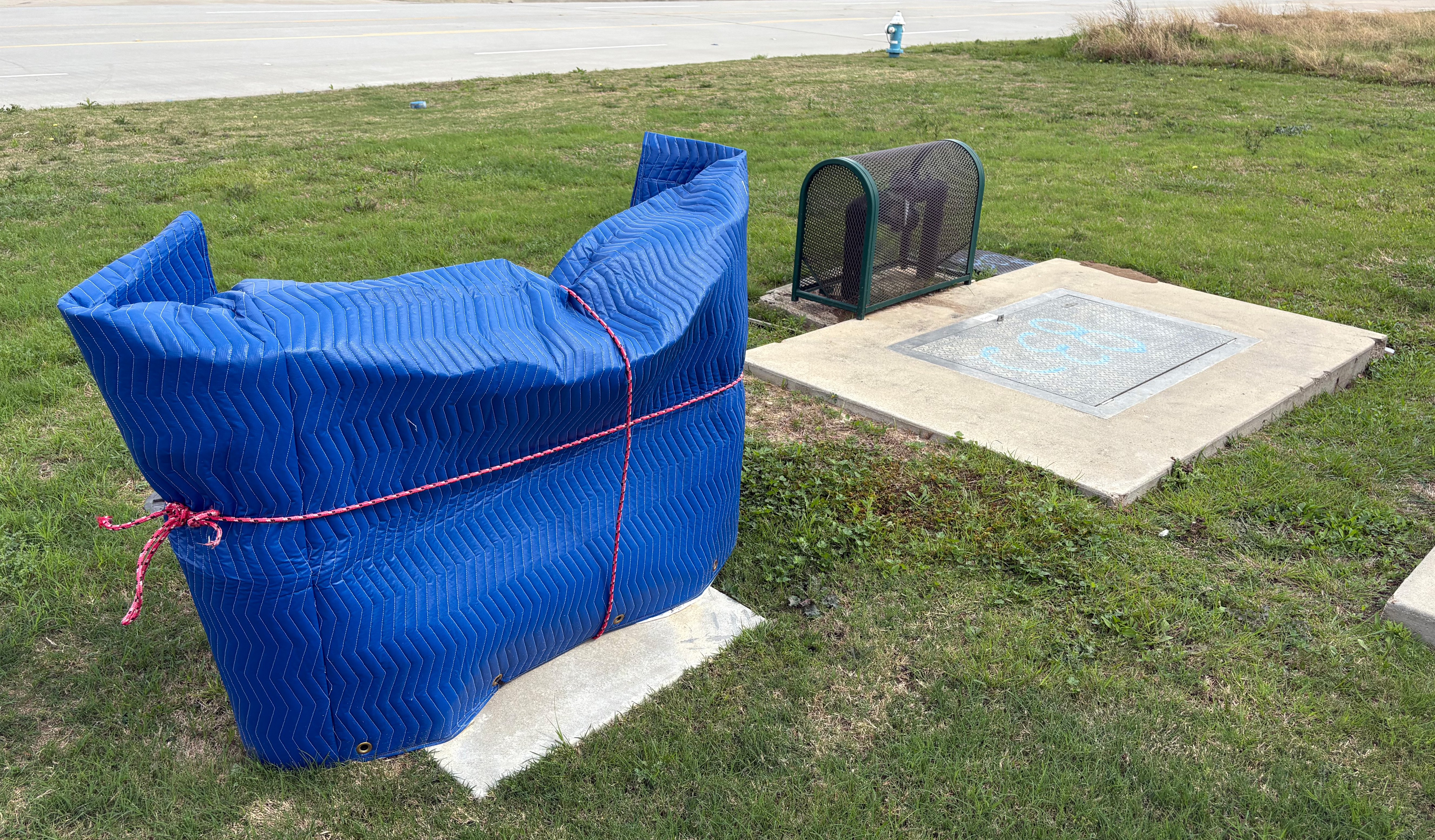
Cages, Bags, Fake Rocks and Vaults: What To Avoid and Why
Backflow preventer covers generally fall into these categories: insulated bags, wire cages, artificial rocks, fiberglass enclosures, vaults and aluminum boxes. While ASSE 1060 above-ground aluminum enclosures are the current standard, legacy options still appear — and each fails on at least one of the four jobs a backflow cover is supposed to do.
Backflow Cages Advertise the Target
Backflow assemblies are built from bronze and copper — prime targets for vandals looking to make a quick profit. A wire cage may delay a thief by a few seconds, but it doesn't conceal the assembly. Cages also offer zero freeze protection and frequently restrict the working clearance required by local plumbing codes. Cities including Scottsdale, Ariz. and Denver have reported widespread thefts from caged assemblies.
Insulated Bags and Blankets
Insulated bags are flexible, weather-resistant pouches that wrap tightly around an assembly for quick, seasonal protection. Most insulated bags and blankets provide basic frost protection, offer no vandalism protection and tend to deteriorate faster than rigid enclosures.
Fiberglass and Fake Rocks Degrade Under UV
Fiberglass enclosures and fake plastic rocks suffer from fiber bloom and UV degradation under extended sun exposure. Typical fiberglass shells crack under weather exposure and must be replaced. Spray foam insulation can detach and leave equipment vulnerable to freeze, snow and frost intrusion. Fake rock covers are designed to blend into landscaping as a discreet theft deterrent, but they typically lack a locking mechanism and rely on passive insulation only.
Below-Grade Vaults Are OSHA-Defined Confined Spaces
Underground utility vaults remain the most common legacy location for backflow installations — and they are the worst option. OSHA classifies all subterranean vaults as confined spaces, which means each entry requires multi-person crews, ventilation, gas detection and rescue equipment. Between 2011 and 2018, more than 1,000 U.S. workers died from occupational injuries involving a confined space, according to the U.S. Bureau of Labor Statistics.
Vaults also flood. A submerged backflow assembly creates a direct cross-connection risk to the potable water supply. The USC Foundation for Cross-Connection Control and Hydraulic Research has urged jurisdictions to stop installing assemblies in subterranean vaults since 2016.
The bottom line: The best place to install a backflow preventer is outdoors, above ground, inside an ASSE 1060-certified enclosure that protects it from freezing, flooding and vandalism while keeping the assembly easy to reach for annual testing. Only ASSE 1060-certified above-ground enclosures address every dimension of the standard: structural strength, drainage, access, security and materials.
Sizing a Backflow Cover Without Overpaying
Enclosure size is the single biggest driver of cost. Specifiers tend to err in one of two directions, and both create problems.
- Too small: Restricts service clearance and can put the install out of compliance with ASSE 1060 access requirements and local jurisdiction rules. Test cocks and valve handles must sit within 24 inches of the access opening.
- Too large: Wastes material cost, adds shipping weight and can create site clearance issues with property lines, sidewalks or landscaping.
Get sizing right by measuring the complete installed footprint: assembly length, width and height including valve handles, test cocks, unions and any meters or isolation valves housed in the same unit. Then add service clearance — typically 6 to 12 inches around the device and 12 inches below the relief valve to prevent water from pooling or freezing at the base.
For most projects, a standard model sized correctly is the right answer. When the assembly configuration is non-standard or the project needs combined meter-and-backflow housing, a custom enclosure is the better path. Custom enclosures from Safe-T-Cover typically ship within one month of first contact. The sizing guide handles single backflow preventer setups; combined or multi-assembly configurations require an engineering review.
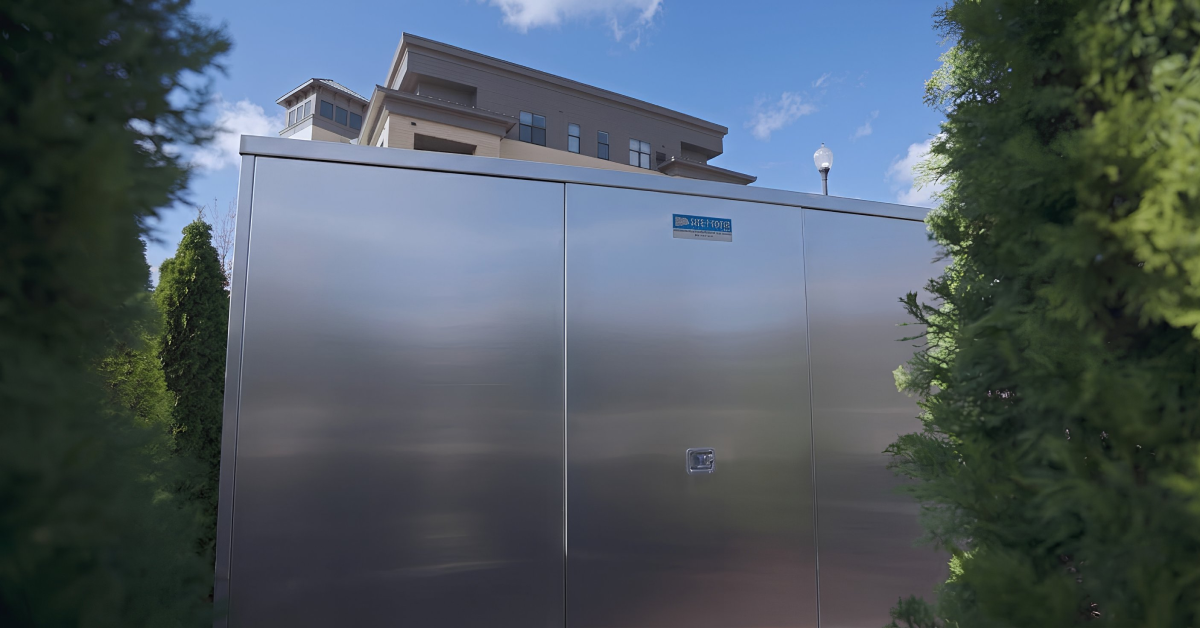
Material Choice: Why Heavy-Duty Marine-Grade Aluminum Wins
ASSE 1060 permits aluminum, stainless steel, galvannealed steel, prepainted galvanized steel, carbon steel, high-density polyethylene (HDPE), natural stone, fiberglass-reinforced plastic and other plastics for exterior wall panels. Each material offers a different mix of durability and insulation value.
In field performance, heavy-duty marine-grade aluminum is the clear leader for durability and long-term protection.
- Lifespan: Marine-grade aluminum enclosures typically last more than 30 years — well past the lifespan of cages or fiberglass.
- Corrosion resistance: Aluminum is lightweight, durable and corrosion-resistant, making it suitable for wet, salty and chemically aggressive environments where vault interiors and outdoor steel both fail fastest. Stainless steel offers some durability but is significantly heavier and more expensive. Rust and pitting are non-issues with marine-grade aluminum.
- UV and weather stability: Aluminum holds finish and structural integrity under direct sunlight, rain and snow where fiberglass and plastics degrade.
- Waterproof construction: Properly sealed seams and drainage paths keep the device interior dry through any weather event.
- Maintenance access: Hinged and removable panels weighing 70 pounds or less (per ASSE 1060 Section 4.0) give testers 360-degree access for testing and repairs without disassembly.
- Theft and vandalism protection: Aluminum enclosures combine a locking mechanism with R-9 polyisocyanurate insulation, delivering both physical security and frost protection in a single unit.
Safe-T-Cover's standard insulation specification is 1.5-inch R-9 in wall panels and 3-inch R-18 in roof panels. During a power outage, the insulation alone is what protects the assembly from the cold — making the R-value as consequential as the heater spec itself.
A Specification Checklist for Engineers
Drop the items below into your backflow enclosure submittal to cover every dimension ASSE 1060 governs.
- ASSE 1060 Class I certified, with manufacturer's certification documentation
- Marine-grade aluminum exterior wall and roof panels
- Minimum 1.5-inch R-9 wall insulation and 3-inch R-18 roof insulation (or equivalent meeting R-value ≥8.0)
- Slab-mounted or wall-mounted heater wired for 120V service, thermostat set to 40°F
- Drainage capability matched to pipe diameter per ASSE 1060 Table 3 (27 GPM for ¼–½ inch, up to 710 GPM for 4-inch and above)
- Hinged or removable access panels, each weighing 70 pounds or less, with restraint hardware in open and closed positions
- Heavy-duty locking mechanism on access panels to deter unauthorized access, vandalism and accidental damage
- Minimum 100 psf vertical structural load capacity suitable for site wind and snow loads
- Test cocks and valve handles located within 24 inches of the access opening
- Minimum 6 to 12 inches of clearance around the assembly; 12 inches below the relief valve
- Concrete pad with appropriate footings sized for assembly and enclosure weight
For jurisdictions writing or revising standard details, the Safe-T-Cover Standard Details Guide includes free, editable CAD templates for fire line double check detector assemblies, N-pattern backflow assemblies, irrigation enclosures and combined meter-and-backflow installations.
Specify the Right Backflow Cover Once. Protect for Decades.
There is no penalty for over-protecting water and no penalty for over-protecting the people who maintain it.
The right backflow cover balances thermal performance with structural security — maintaining optimal operating temperatures inside the enclosure while preventing the physical damage that puts backflow preventers out of service.
A Class I, ASSE 1060-certified marine-grade aluminum backflow cover is the spec that addresses every threat to a backflow assembly: freeze events, theft, flooding, cross-connection risk and the safety hazards of confined-space testing. Specify it once and the assembly is protected for the next 30-plus years.


.jpg?width=206&name=MadeInUSA-Icon%20(1).jpg "MadeInUSA-Icon (1)")