A cross-connection control program is how water authorities prevent contaminated water from reversing into the public supply. However, not all U.S. public water systems have an active program. Five pillars determine whether a program succeeds or collapses — and where backflow preventers are physically installed affects all five.
Every connection to a public water system is a potential path for contamination. Cross-connection control is how water authorities close those paths before something goes wrong. The push to make these programs mandatory has been underway for more than 100 years, and yet the gap between policy and practice remains significant.
If you're building a program from scratch — or shoring up one that exists only on paper — this guide covers what a functional program requires, where programs most often break down and why installation location matters more than most water authorities realize.
What Is a Cross-Connection Control Program?
A cross-connection control (CCC) program is a formal, enforced system a water authority uses to identify, document and eliminate connections between potable water lines and any source that could introduce contamination. The goal is to prevent backflow, the reversal of water flow that can draw pollutants or chemicals into the drinking water supply.
The program assigns responsibility, establishes testing schedules and gives the water authority legal authority to act when a hazard is found or a device is not maintained.
Cross-Connection vs. Backflow: What's the Difference?
A cross-connection is any actual or potential link between a potable water system and a non-potable source, like the hose submerged in a pool or the irrigation system connected to the municipal supply. Backflow is what happens when hydraulic conditions reverse water flow through that connection.
Two conditions cause backflow:
- Backsiphonage occurs when a pressure drop — from a main break, nearby fire suppression activity or other event — creates a vacuum that draws contaminated water upstream.
- Back pressure occurs when downstream pressure exceeds supply pressure, forcing water back into the distribution system.
Either condition, left unprotected, can introduce E. coli, pesticides, boiler chemicals or other contaminants into drinking water lines.
A backflow prevention device stops that reversal. The cross-connection control program makes sure those devices are present, correctly installed and working.
Who Mandates CCC Programs?
The Safe Drinking Water Act (SDWA), first enacted in 1974, requires all public water systems to deliver safe drinking water. The Environmental Protection Agency's regulations under the SDWA set minimum quality and distribution standards.
While the act doesn't name cross-connection control programs explicitly, each state drinking water agency can interpret those distribution standards for their backflow prevention programs. As a result, state and local regulations vary.
The American Water Works Association (AWWA) is unambiguous in its policy: the return of any water to the public supply after use on a customer's premises is unacceptable. AWWA Manual M14 — the standard reference for backflow prevention programs — requires hazard assessments, on-site surveys and enforcement procedures as components of a complete program.
How Many Public Water Systems Have a Cross-Connection Control Program?
The exact number is unknown. According to 10-year-old research, the American Backflow Protection Association once estimated that fewer than 40 percent of U.S. public water systems were protected by a CCC program.
Field surveys reinforce this. HydroCorp, a cross-connection control program specialist, found that about 30 percent of service connections within a public water system are non-compliant — even in systems that believe they're operating a CCC program. The most common problems: missing backflow prevention on hose bibbs, boiler systems and process tanks, and incorrect or improperly installed devices on irrigation and fire suppression systems.
The CDC reports 1.1 million people get sick annually from germs in drinking water. Backflow events are a documented contributor. The absence of CCC programs — or programs that exist only as paperwork — is a direct public health risk.
Getting a program approved isn't fast. Approvals from state and local government can take years. Once in place, the program demands sustained attention. That gap between starting and succeeding is where most programs lose ground.
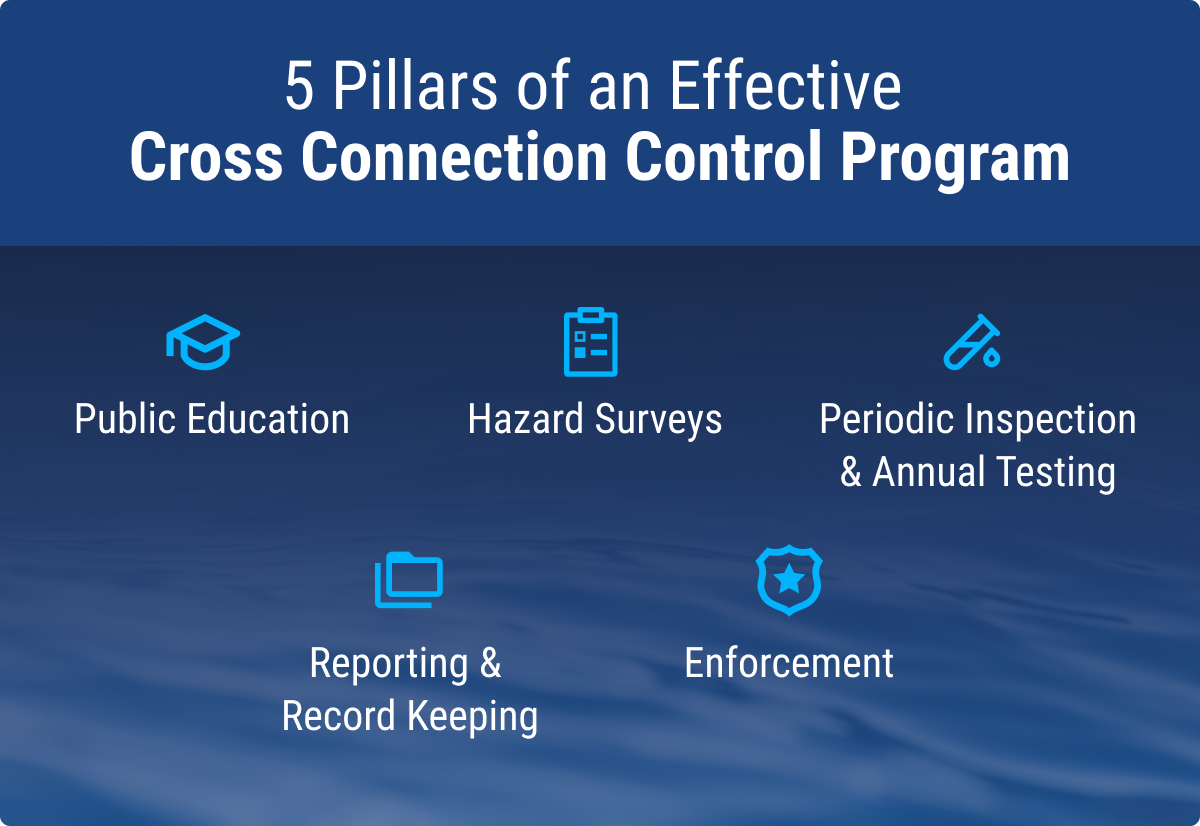
The 5 Pillars of an Effective Cross-Connection Control Program
Let's assume you already have government approval to ensure the protection of your water supply. Here are some of the best practices and keys to a successful and efficient CCC program:
1. Public Education
Most water users have no idea what backflow is or why their participation in a CCC program matters. Several municipalities have had CCC programs challenged or overturned by residents and local officials who weren't educated on why the program exists and what it costs to maintain.
According to HydroCorp's public awareness guidance, framing a CCC program as a regulatory compliance exercise or using fear tactics backfires. Water users who believe the utility is only acting because it has to are less likely to comply with testing requirements or report plumbing changes. The message that works is straightforward: this program protects the water your community drinks.
Public education isn't a one-time notice. It's a sustained effort that informs new water users, explains testing requirements and clarifies what property owners are responsible for.
2. Hazard Surveys
A hazard survey locates and documents every possible cross-connection in the distribution system. Every device is identified by serial number, documented and entered into a tracking system searchable by the water authority.
Commercial, industrial, institutional and municipal properties all carry different hazard profiles as outlined by state plumbing codes, local water purveyors and guidance from organizations such as the AWWA and USC Foundation for Cross-Connection Control and Hydraulic Research (USC-FCCCHR). For example, dual check valve assemblies are approved for low-hazard applications only, while RPZ assemblies are required for high-hazard connections, including industrial lines.
A backflow preventer documented as installed in a below-grade vault is flagged differently than one in an above-ground enclosure. Vault installations carry their own cross-connection risk, which we cover in our backflow prevention best practices guide.
3. Periodic Inspection and Annual Testing
Every testable backflow prevention assembly in the water system must be inspected and tested on a regularly scheduled basis. Annual testing is the established best practice. Testing confirms check valves are seating properly and the assembly is performing as designed. It also creates a dated record of the system's condition, essential for identifying devices that are deteriorating before they fail.
Most state regulations require testing at installation, after any repair or relocation and at least annually. Some jurisdictions require more frequent testing for high-hazard applications.
4. Reporting and Record Keeping
Every test, repair and maintenance action must be documented and stored in a system the water authority can search at any time. The record should capture the device serial number, location, test date, test results, the name of the certified tester and any corrective action taken.
Purpose-built software for backflow tracking exists across a range of price points. These tools send testing notices to property owners, accept test results from certified testers in the field and generate compliance reports for state sanitary surveys. The software is a resource, not a substitute for field verification.
Records also support enforcement. When a device hasn't been tested or a property owner disputes a notice, the record resolves it. Without accurate records, enforcement has no foundation.
5. Enforcement
Every other pillar of the program depends on enforcement. Hazard surveys mean nothing if non-compliant connections aren't corrected. Likewise, annual testing requirements mean nothing if untested devices have no consequence.
Enforcement means three things in practice: notifying property owners of testing requirements with clear deadlines, issuing penalties or service interruptions for non-compliance, and applying those consequences consistently — with no exceptions, no grandfather clauses and no friendly oversights.
Here are a few ways states and cities have enacted enforcement:
- The City of Houston's CCCP illustrates what enforcement authority looks like in practice: citations carrying fines of up to $2,000 per day for non-compliance with risk of water service suspension. Programs without comparable tools depend on voluntary compliance, which is not a water safety strategy.
- Utah mandates that an authorized administrator keep the entire program on a regular schedule.
- The Illinois EPA notes that "soaring liability insurance costs" — with exclusionary clauses for pollution-related claims — have started to affect water suppliers that don't enforce stringent CCC programs.
- Las Vegas charges a small monthly fee based on meter size so that all equipment can be maintained by the water jurisdiction; this shifts the burden off the property owner and allows the city to better control cross-connections that may introduce harmful contaminants into drinking water.
- Massachusetts' Department of Environmental Protection offers a Cross-Connection Control Best Practices Guide which states that water authorities "are responsible for ensuring the water they deliver meets federal and state standards, and that quality is not compromised within the distribution system."
Remember, any connection to your water system is a potential contamination source. A program that makes exceptions trains the system to expect them.
Common Reasons Cross-Connection Control Programs Fail
|
Failure |
Why It Happens |
What To Do Instead |
| Software-only compliance | Utilities track test results digitally but skip field-based audits | Combine backflow tracking software with regular on-site hazard surveys |
| Inconsistent enforcement | Exceptions made for long-standing accounts or difficult property owners | Apply testing and compliance requirements to every service, no exceptions |
| Outdated or missing standard details | Engineers default to whatever was done on prior projects, often vault installations | Publish jurisdiction-specific standard details for above-ground enclosures |
| No dedicated budget | CCC program is treated as an administrative function without its own line item | Budget for staffing, field surveys, software and enforcement infrastructure |
| Lack of legal authority | Program exists in policy but the utility lacks ordinance authority to enforce | Establish a CCC ordinance that gives the water authority authority to inspect, require corrective action and terminate service for non-compliance |
Where You Install Backflow Preventers Affects Your CCC Program
Your program identifies hazards and requires devices to protect against them. But the device's installation location determines whether it can actually do its job — and whether it creates new problems in the process.
Underground vaults create the cross-connection risk you're trying to prevent.
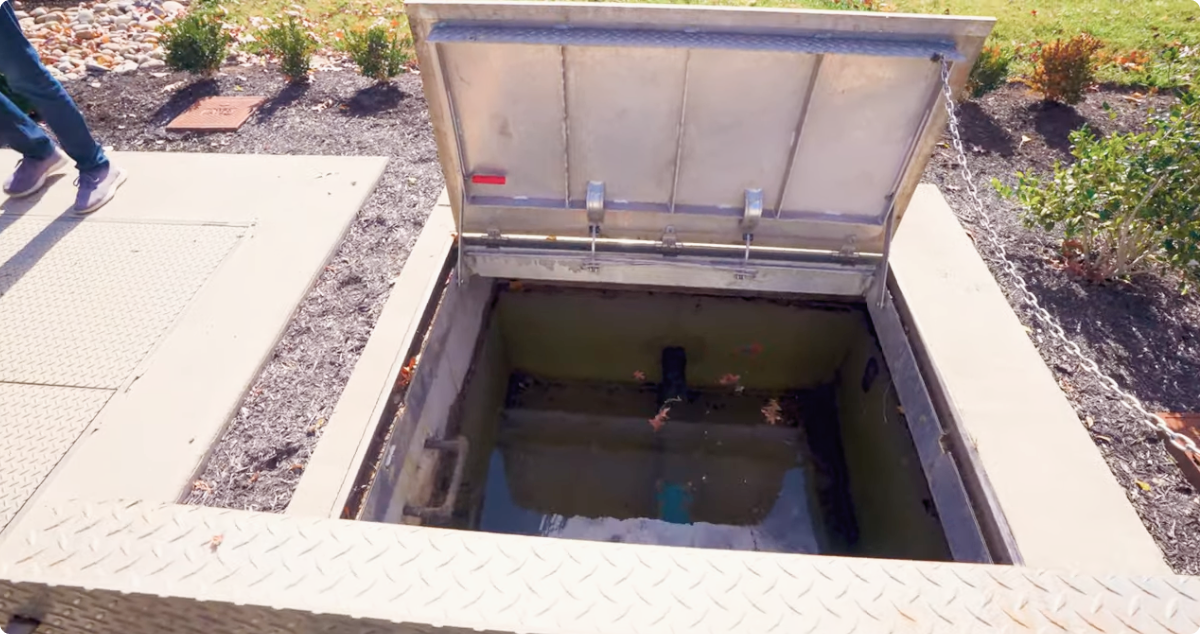
For decades, underground utility vaults were the default installation choice for backflow assemblies. They remain common in standard details that haven't been updated. The problem: vaults flood, and a submerged backflow preventer is a direct cross-connection threat to the potable water supply.
When a vault takes on water — from groundwater intrusion, surface runoff or storm events — the backflow assembly is submerged. Submerged test cocks cannot function. If a backflow event occurs while the device is underwater, contaminated vault water can enter the distribution system through the very assembly installed to prevent it. After Hurricane Harvey, flooded vaults throughout Houston demonstrated exactly this risk at scale.
The USC Foundation for Cross-Connection Control and Hydraulic Research has warned against below-grade installations for nearly two decades, citing the contamination risk in multiple issues of Cross Talk. The USC-FCCCHR's position is that below-grade vault installations undermine the cross-connection control programs they're supposed to support.
Vaults also introduce OSHA-defined confined space hazards. Testers entering below-grade vaults face slippery surfaces, tight clearances, poor air quality and the risk of falls. Between 2011 and 2018, more than 1,000 workers in the U.S. died from occupational injuries involving confined spaces, according to the U.S. Bureau of Labor Statistics.
Above-Ground Enclosures Support Testing Compliance and Reduce Liability
Above-ground, ASSE 1060-certified enclosures eliminate vault flooding risk, remove confined space exposure and make annual testing faster and more consistent. All benefits directly support CCC program compliance.
Testing throughput is the practical difference. A backflow tester working vault-to-vault can complete approximately six tests per day because of OSHA safety protocols and gatekeeper delays involved in vault access. The same tester working curbside above-ground installations can complete approximately 30 tests per day. For a water authority managing hundreds or thousands of assemblies, that difference determines whether annual testing is operationally achievable.
Above-ground enclosures also protect the assembly itself. Wet, corrosive vault environments accelerate component degradation. A marine-grade aluminum enclosure keeps assemblies dry, insulated and protected from temperature extremes. Safe-T-Cover enclosures are designed to last more than 30 years, essentially outlasting the equipment inside them.
.png?width=1200&height=634&name=Enclosure%20(1).png)
Look for ASSE 1060 Certification
ASSE 1060 is the national standard for outdoor enclosures protecting backflow preventer assemblies. An ASSE 1060-certified enclosure meets tested performance thresholds for freeze protection, structural integrity, security and drainage. ASSE 1060 Table 3 governs drainage requirements — specifically the capacity to manage RPZ relief valve discharge, which can reach 200 to 300 gallons per minute when a check valve fails or debris prevents seating.
Wire cages and fiberglass enclosures typically do not meet ASSE 1060 requirements. A cage offers no freeze protection, no drainage capacity and no structural security. A fiberglass enclosure may provide some thermal protection but not all meet the structural and drainage thresholds.
When specifying enclosures for a CCC program, ASSE 1060 certification is the threshold. Anything below that threshold represents a gap between the program's intent and its execution.
How Municipalities Are Bringing Their Standards Up-to-Date
Several water authorities have moved from outdated vault-based standard details to published, above-ground specifications. Here are a few that stand out.
|
Municipality |
What Changed |
Result |
| Las Vegas Valley Water District | Shifted from underground vault rehabilitation to above-ground aluminum enclosures for the same backflow equipment | Saving as much as $60,000 per installation by eliminating vault rehab costs |
| Arlington, Texas | Surveyed 1,200 civil and plumbing engineers; found critical gaps in installation standards. Published containment and isolation guidelines for non-residential projects | Became the first city in north-central Texas to publish above-ground backflow enclosure standard details. Engineers now have exact specifications to copy into plans. |
| New Jersey | Revised state guidelines to require curbside, above-ground installations | Eliminated confined space exposure for workers, reduced excessive 811 mark-outs |
| Fayetteville, N.C. | Developed standard details that exceed state and federal requirements | Maintains a clean water supply for more than 500,000 residents |
The Safe-T-Cover Standard Details Guide includes editable CAD templates for above-ground enclosure installations that engineers and water jurisdictions can copy directly into plans, reducing design time and eliminating guesswork.

Keep Drinking Water Safe
A cross-connection control program built on the five pillars — public education, hazard surveys, annual testing, accurate records and real enforcement — can reliably protect the water supply. Most programs fail because one or more of those pillars is missing, under-resourced or applied inconsistently.
Installation location is the element most often overlooked at the design and specification stage. Underground vault installations introduce the very risks a CCC program exists to manage. Above-ground ASSE 1060-certified enclosures eliminate vault flooding risk, remove confined space exposure for testers and make annual testing operationally achievable at scale.
Safe-T-Cover manufactures ASSE 1060-certified above-ground aluminum enclosures designed specifically for above-grade backflow preventer installation. Contact us via chat to discuss specifications and support for your jurisdiction.

.jpg?width=206&name=MadeInUSA-Icon%20(1).jpg "MadeInUSA-Icon (1)")